Every few years I rebuild this website, and every few years I wonder why I keep doing it to myself. This post is a tour through the versions — from table layouts to structured data. Most of it is reconstructable thanks to the Wayback Machine, which has been quietly archiving my digital garden since long before I knew what a digital garden was.
2000/2001 – stuff.de.tf: Dreamweaver and the free-hosting food chain
Before this domain there was stuff.de.tf — a free subdomain from the German de.tf domain service, created around the turn of the millennium. My tools: Macromedia Dreamweaver, a dial-up connection, and a lot of confidence in <table> as a layout primitive.
What I remember as "my website" was actually one link deeper in the free-hosting food chain. The Wayback Machine preserved the page from August 2002, and it is a perfect period piece: a frameset whose content frame points to a Geocities page, and whose footer frame points to yet another free host:
<HTML><HEAD>
<TITLE>...:::STUFF.de.tf:::...</TITLE>
<META name="LANGUAGE" content="Deutsch,DE,AT,CH">
</HEAD>
<frameset rows="100%,*" border="0" frameborder="0">
<FRAME SRC="http://de.geocities.com/quickscottish/album/index.htm" scrolling="auto">
<FRAME scrolling="no" noresize>
</frameset>
</HTML>
Free domain on top of free hosting inside free frames — a three-level house of cards that somehow stayed standing until about 2005, where the last archive captures end. Dreamweaver generated half the HTML and I repaired the other half by hand; frames, animated GIFs and hit counters were state of the art.
2016 – October CMS: the domain finally arrives
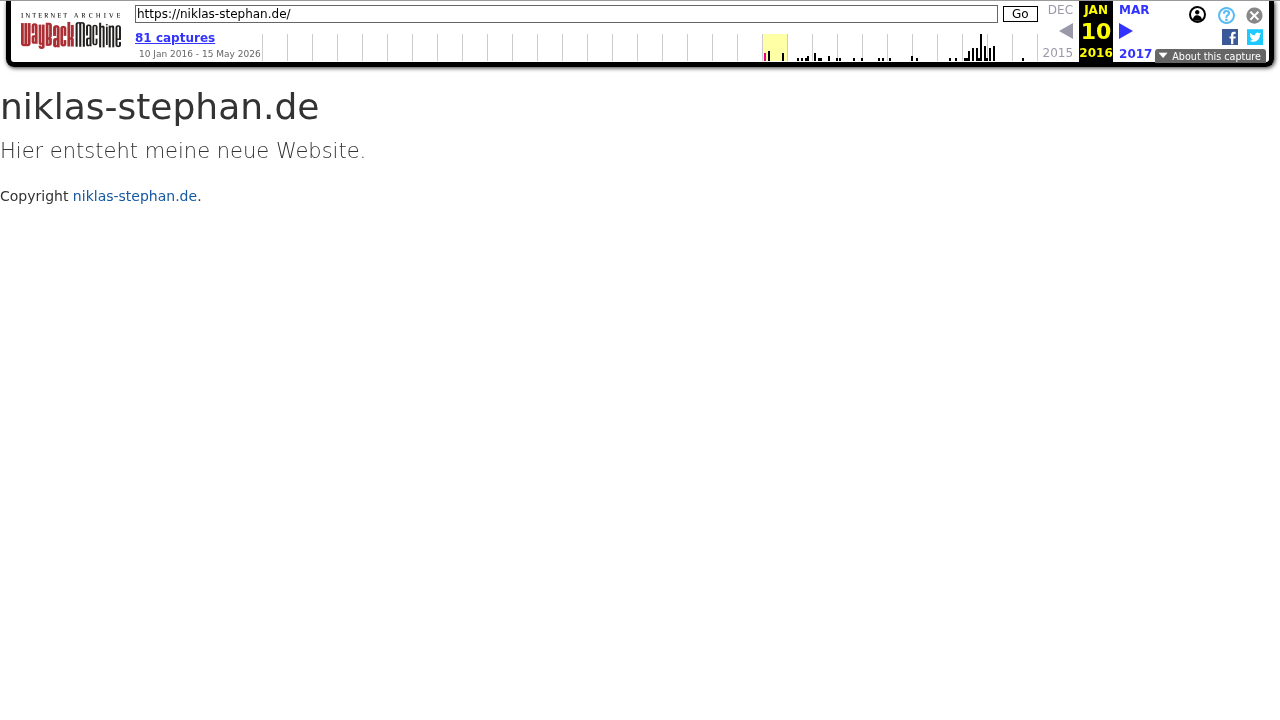
In January 2016 niklas-stephan.de went online (first archive capture: 2016-01-10) — with October CMS, Bootstrap 3 and a dark "cover"-style theme. A centered name, one sentence, and a small portfolio of projects, including the website of our Scottish terriers, which was apparently "the first project ever built on this technical basis" according to its own project card. Even my own name wasn't deployed without bugs: the author meta tag of the first version cheerfully read "Niklas Stepahn".
2017-2025 – WordPress: the long marriage
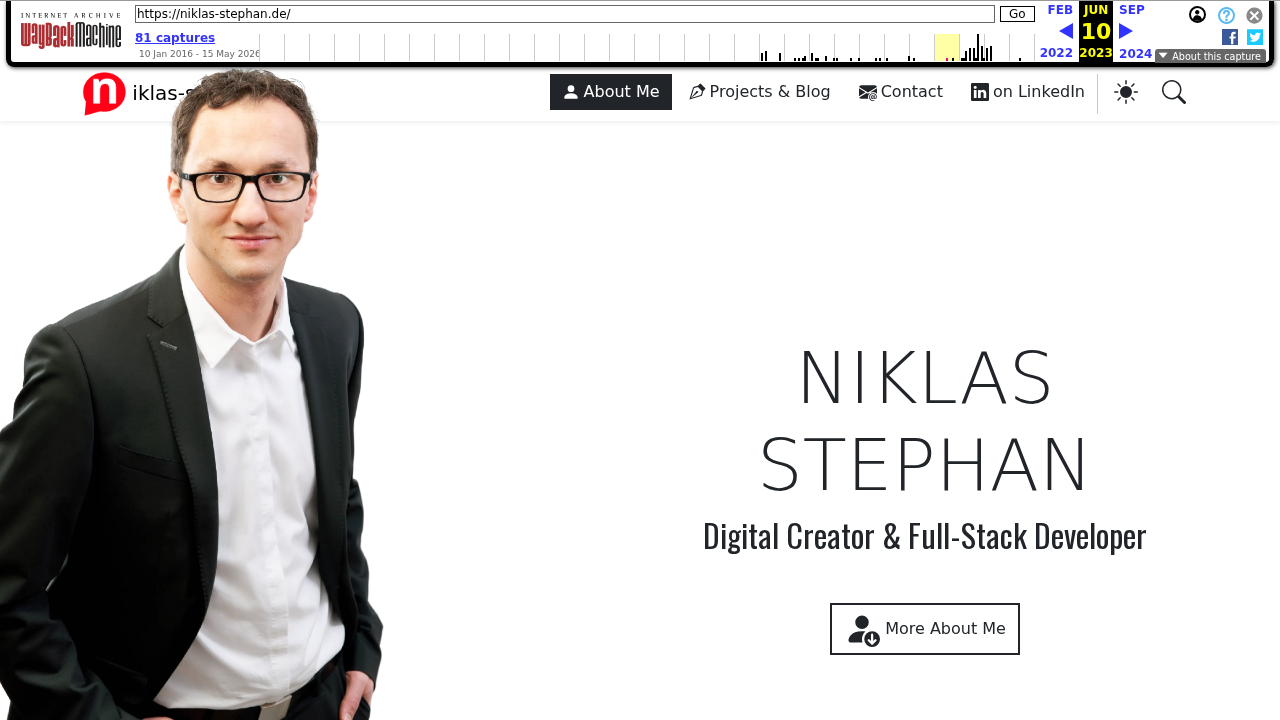
In autumn 2017 the site moved to WordPress, with a custom theme (subtly named niklas) whose front page used image panels — my guitar, a cloud, a fiber-optic box — laid out in a grid. This is where the site became a blog: how-tos about Windows passwords, BOINC, IR remotes and SSH with VS Code, bilingual via a ?lang= toggle.
The marriage had its arguments. By 2022 I was already looking sideways at other systems (NCMS), and in November 2025 I wrote its eulogy (Herr Doctor, I have WordPress — can anything still be done about it?). Plugins piled up, every update was a small lottery, and a large part of the codebase existed only to make WordPress behave like a fast static website.
2022 – nCMS: when I built my own CMS on Node-RED
Because "not quite satisfied with what exists" is a valid reason, I spent one month in early 2022 building nCMS — "niklas stephan's Content Management System", "node-red Content Management System", or "not another Content Management System", depending on the day. A flat-file, headless CMS with Node-RED in the backend and Node.js functions inside it: content deployed via Node-RED or webhooks, files versioned through Git, everything rendered to static files for speed. Multi-language posts, comments, media uploads, SEO metadata, full-text search — and deliberately no frontend framework. It ran live on a subdomain while the main site stayed on WordPress, and I documented the whole experiment on the blog. Some ideas from it — static-first, everything-as-code, webhooks as deploys — quietly returned in later versions of this site.
2025/2026 – Outline and Hugo
From late 2025 the writing itself moved to Outline, the wiki tool that hosts this site's docs section, and on 3 January 2026 I relaunched on a Hugo-generated static site: a Go program pulling posts from the Outline API, Hugo rendering them, a minimal Go web server with an update webhook, everything in one Docker container under supervisord. Hugo served the site for its first few months of 2026 — the cleanest architecture I had run so far, and the direct ancestor of today's setup (Website Relaunch 2026, concept: the near-perfect website).
March 2026 – Grav: everything as a repository
In March 2026 the content migrated to Grav, and with it the current architecture: three Gitea repositories — pages (grav-site), config (grav-config) and the theme — each pushing through a webhook that validates, deploys, backs up and mirrors the site. A content change is now a git push, and a broken front-matter change is caught by a validator before it ever reaches the server. That's the version of "everything as code" that nCMS and the Hugo experiment were both reaching for.
November 2026 – the current build
The current version still runs Grav, but hardly anything else from the March setup survived:
- a custom theme (grava-the-hud, a fork of Quark 2) with a HUD look, a WebGL wireframe head on the About page and an ambient grid background
- a proper brand: signal-trace mark, wordmark set in Cal Sans, matching favicon — in the brand green
#18A98A - client-side performance: gzip at the application layer,
must-revalidatewith ETags so clients always get the latest version, immutable caching for fingerprinted assets - structured data (JSON-LD
Person,BlogPosting,og:image) so the site and the face belong to the same entity - everything running in a pinned Docker container behind Traefik on my own homelab server, with the mail contact on its own spam-honeypot alias
What stayed
Twenty-five years, six platforms: Dreamweaver frames, October CMS, WordPress, a hand-built Node-RED CMS, Hugo, Grav. What survived all of them is the domain, my name misspelled in at least one era's metadata, and the same reason for having a site at all — a place where the things I build and learn end up where I control them. And a recurring dream, visible in every era: a fast, clean, self-owned website that just works. The next rebuild is probably already overdue.